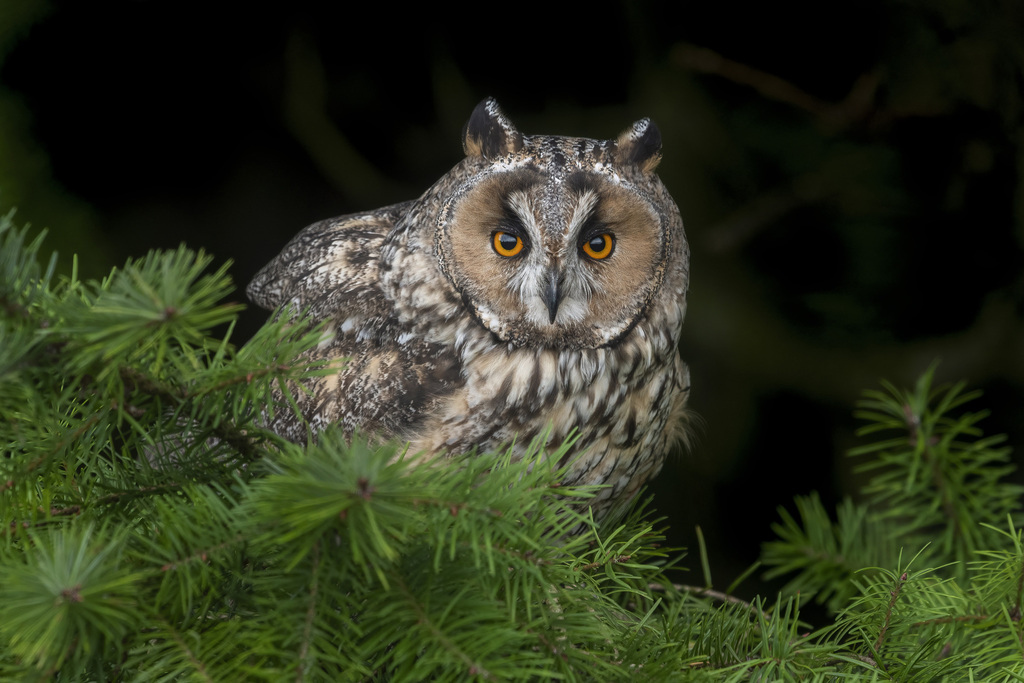
Long-Eared Owl
Asio otus
Also known as: Northern Long-Eared Owl
Habitat
Ground
Diet
VertFishScav
Active Time
Nocturnal
Size
297 g
About This Species
This owl hunts open fields, grassland, and rough pasture at night for voles and other small mammals, but by day it roosts quietly and inconspicuously in dense conifers or thick hedgerows, often communally with several birds together in winter. Listen at dusk for a low, evenly spaced hooting, and look for its long, upright ear tufts if you find a daytime roost. Winter is the best season, when communal roosts form and are more predictable than solitary breeding-season birds.
Ethical Viewing Guidelines
- Keep well back from any daytime roost and view with binoculars rather than approaching the roost tree directly, since flushing a roosting owl in daylight forces it into a vulnerable, exposed position.
- Owls and their roosts and nests are protected under wildlife legislation in most of its range across Europe, North America, and Asia, though the exact provisions vary by country.
- Avoid lingering under a known roost or drawing attention to its location, since repeated visits can cause the birds to abandon the site.
LCAvesStrigiformesStrigidae
Seasonal Activity
346,798 sightings · 2000–2026
Citizen science records via GBIF
All monthsThis month
Classification
- Kingdom
- Animalia
- Phylum
- Chordata
- Class
- Aves
- Order
- Strigiformes
- Family
- Strigidae
Traits
- Diet
- VertFishScav
- Foraging
- Ground
- Activity
- Nocturnal
- Body mass
- 297 g
Photo
(c) caroline legg, some rights reserved (CC BY)
CC-BY-4.0
Occurrence data from GBIF.