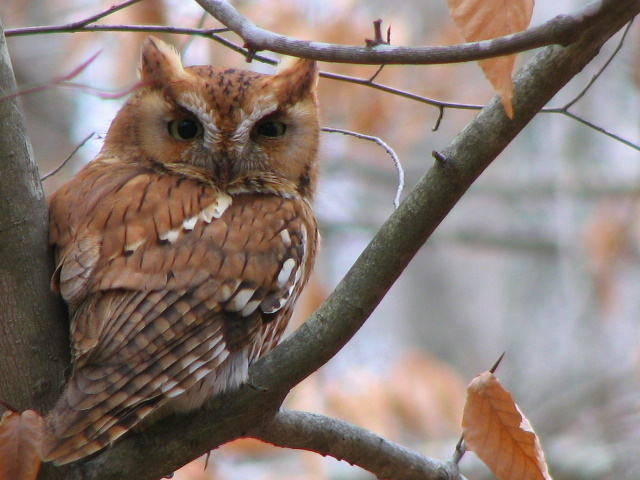
Eastern Screech-Owl
Megascops asio
Also known as: Autillo Yanqui
About This Species
This small owl is best detected by its distinctive descending whinny or soft trill given after dark from woodland edges, parks, and suburban areas with mature trees offering cavities to roost and nest in. Its cryptic grey or reddish plumage makes it extremely difficult to spot by day, so listening at dusk and through the night, especially in early spring when calling activity peaks around pair formation and nesting, is far more productive than searching visually. Playback of its call can draw a response but should be used sparingly, if at all, to avoid disturbing courting or nesting pairs.
Ethical Viewing Guidelines
- Observe from a distance without shining bright lights directly at a roosting or calling bird for extended periods, since repeated close-range disturbance at a nest cavity can cause a pair to abandon it.
- Protections for native owls and their nest cavities vary across the range of this species, so avoid assuming uniform rules and default to minimal, brief observation.
- Limit the use of recorded calls to draw the bird out, since excessive playback near an active nest is a recognised source of disturbance to nesting owls.
Seasonal Activity
463,683 sightings · 2000–2026
Citizen science records via GBIF
Classification
- Kingdom
- Animalia
- Phylum
- Chordata
- Class
- Aves
- Order
- Strigiformes
- Family
- Strigidae
Photo
(c) Michael Hodge, some rights reserved (CC BY-NC-SA)
CC-BY-NC-SA-4.0
Occurrence data from GBIF.