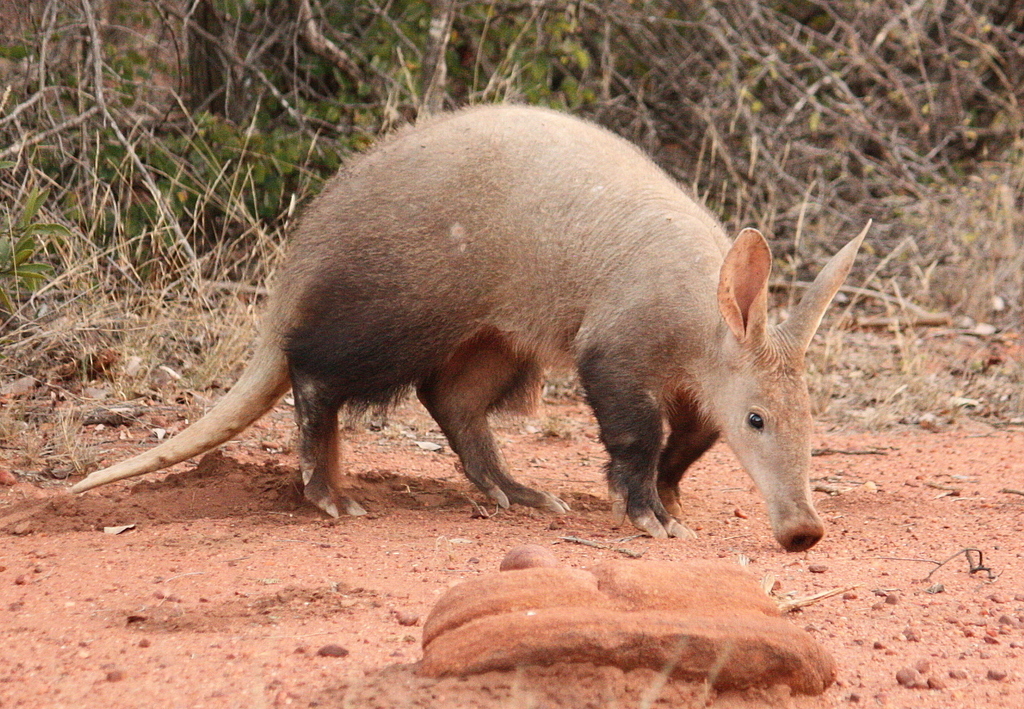
Aardvark
Orycteropus afer
Also known as: Antbear
Habitat
Ground
Diet
Invertebrate
Active Time
Nocturnal
Size
52.4 kg
About This Species
A stocky, pig-sized mammal that roots through open savanna, woodland, and scrub in search of termite mounds and ant colonies, using its powerful claws to excavate with surprising speed before probing deep with a long, sticky tongue. Look for freshly torn-open termite mounds and characteristic conical burrow entrances in sandy or loamy soils; at night, listen for the soft rhythmic scraping and snuffling as it forages, and watch for the distinctive arched-back silhouette moving steadily across open ground with its long snout held low. Spotlight drives along dirt tracks through bushveld on warm, overcast nights offer the best chance of an encounter, particularly during the wet season when termites are most active and individuals forage more widely and boldly.
Ethical Viewing Guidelines
- Maintain a minimum distance of 10–15 metres and avoid using artificial light sources during nocturnal observations, as sudden illumination can cause significant stress and disrupt foraging behaviour.
- Across its sub-Saharan range, it receives protection under national wildlife legislation in many countries, including South Africa's National Environmental Management: Biodiversity Act and equivalent laws in Kenya, Tanzania, and Botswana, so always obtain any required permits before conducting fieldwork or guided night watches.
- Stay downwind, keep group sizes small, and withdraw immediately if the animal shows signs of alertness such as pausing, ear-raising, or a change in direction, as repeated disturbance can reduce foraging efficiency and condition.
Seasonal Activity
1,321 sightings · 2001–2026
Citizen science records via GBIF
Classification
- Kingdom
- Animalia
- Phylum
- Chordata
- Class
- Mammalia
- Order
- Tubulidentata
- Family
- Orycteropodidae
Traits
- Diet
- Invertebrate
- Foraging
- Ground
- Activity
- Nocturnal
- Body mass
- 52.4 kg
Photo
no rights reserved, uploaded by Kelly Abram
CC0-1.0
Occurrence data from GBIF.