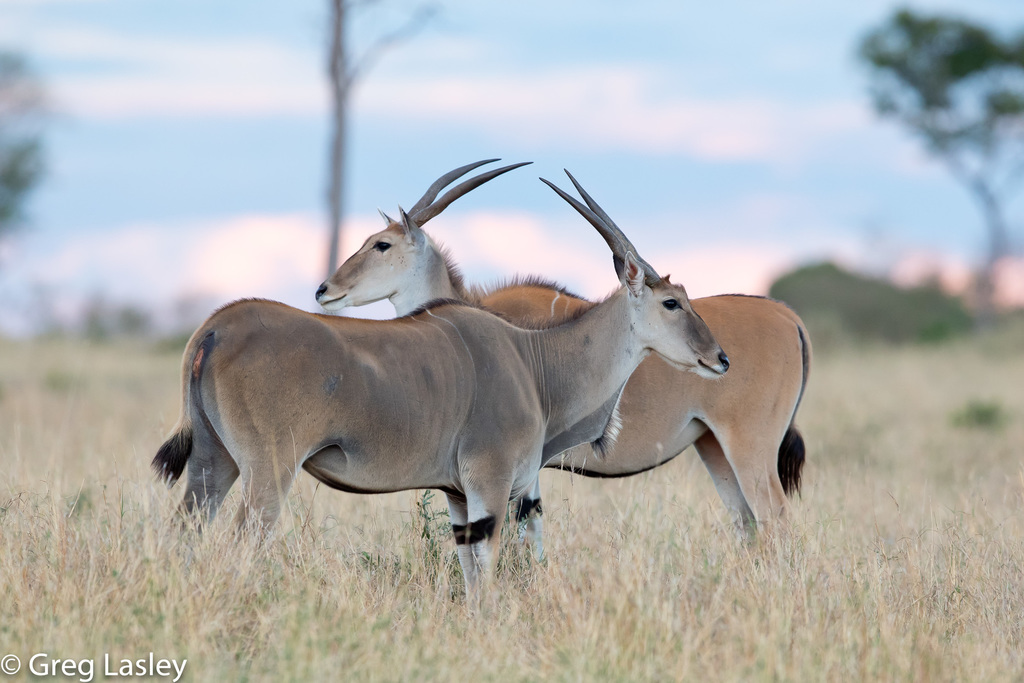
Common Eland
Taurotragus oryx
Also known as: Eland, Cape Eland, East African Eland, Livingstone's Eland
Habitat
Ground
Diet
PlantSeed
Active Time
Diurnal
Size
570.0 kg
About This Species
These large, ox-like antelopes favor open savanna, woodland edges, and semi-arid scrub, where they browse and graze in loose herds that shift widely across the landscape in search of fresh growth. Watch for the distinctive clicking sound produced by the carpal joints as they walk — audible from some distance — and look for the dewlap, spiraling horns present in both sexes, and the faint white flank striping that can catch the light in open terrain. The dry season, when vegetation thins and herds congregate around remaining water and green patches, offers the most reliable sightings, particularly in the cooler hours of early morning when animals are most actively feeding before resting through the midday heat.
Ethical Viewing Guidelines
- Maintain a minimum distance of 50–100 metres, using binoculars or a telephoto lens to observe without causing flight responses, and remain especially cautious around breeding herds and calves.
- Across their range in eastern and southern Africa, they are protected within national parks and reserves under legislation such as South Africa's National Environmental Management: Biodiversity Act (NEMBA) and equivalent wildlife laws in Kenya, Tanzania, and Botswana, where disturbance, pursuit, or feeding is prohibited.
- Stay in designated vehicles or marked trails, avoid sudden movements or loud noise, and never position yourself between individuals or attempt to approach on foot in unfenced areas.
Seasonal Activity
6,177 sightings · 2000–2026
Citizen science records via GBIF
Classification
- Kingdom
- Animalia
- Phylum
- Chordata
- Class
- Mammalia
- Order
- Artiodactyla
- Family
- Bovidae
Traits
- Diet
- PlantSeed
- Foraging
- Ground
- Activity
- Diurnal
- Body mass
- 570.0 kg
Photo
(c) Greg Lasley, some rights reserved (CC BY-NC), uploaded by Greg Lasley
CC-BY-NC-4.0
Occurrence data from GBIF.