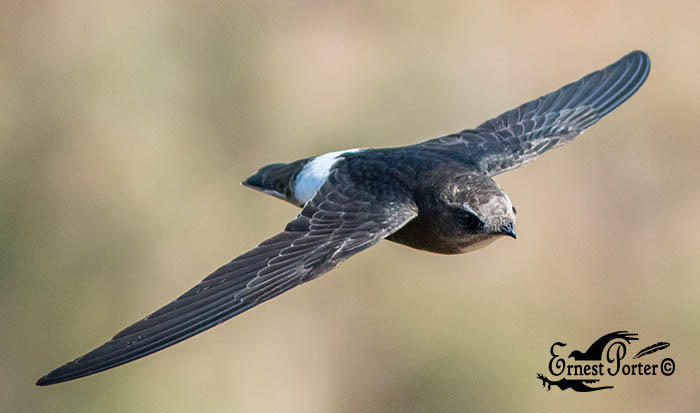
Little Swift
Apus affinis
Also known as: House Swift, Ababil
Habitat
Aerial
Diet
Invertebrate
Active Time
Diurnal
Size
23 g
About This Species
Scan the sky near cliffs, bridges and buildings for small, fast-flying swifts with a shallow forked tail and a pale rump patch, wheeling in tight groups while screaming as they feed on aerial insects. Colonies nest under eaves, bridge girders or on cliff faces, and dusk gatherings around a colony are often the easiest time to watch large numbers together. It is a resident or short-distance migrant across much of its African and Asian range, so it can typically be found near known colonies for much of the year.
Ethical Viewing Guidelines
- Observe nesting colonies from ground level without approaching or touching nest sites under bridges or eaves, since swifts are easily flushed and repeated disturbance can cause them to abandon a colony.
- Protection for nesting birds and their nest structures differs between the many countries across its range, so do not assume the same rule against disturbing an active nest applies everywhere.
- Where local law is unclear, simply keep to public areas and refrain from disturbing any structure with active nests.
Seasonal Activity
497,342 sightings · 2000–2026
Citizen science records via GBIF
Classification
- Kingdom
- Animalia
- Phylum
- Chordata
- Class
- Aves
- Order
- Apodiformes
- Family
- Apodidae
Traits
- Diet
- Invertebrate
- Foraging
- Aerial
- Activity
- Diurnal
- Body mass
- 23 g
Photo
(c) Ernest Porter, some rights reserved (CC BY-NC), uploaded by Ernest Porter
CC-BY-NC-4.0
Occurrence data from GBIF.