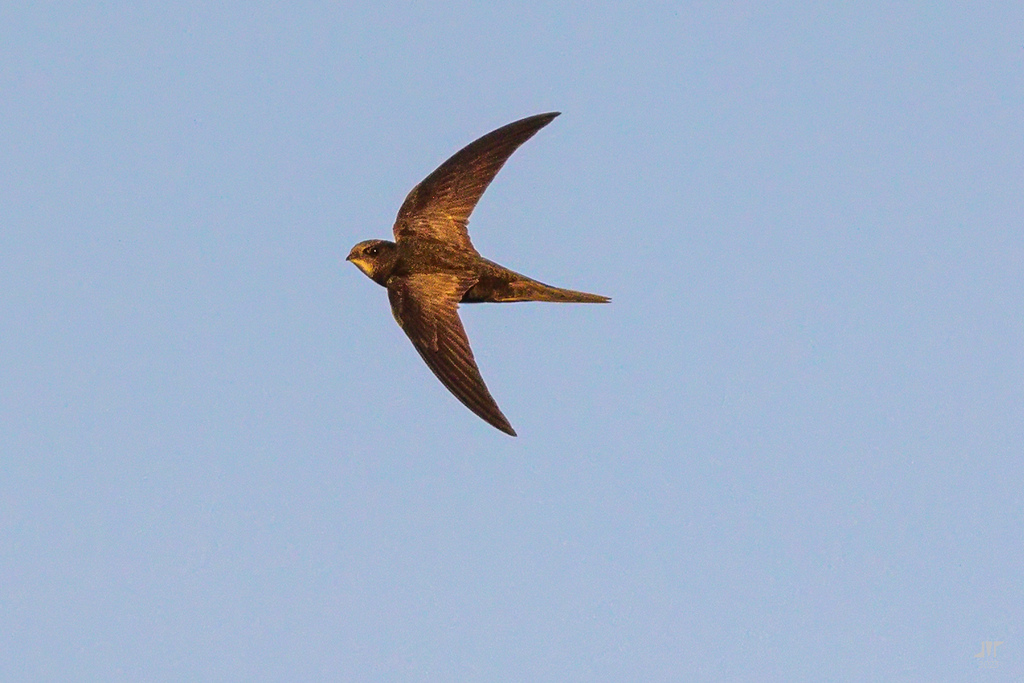
Common Swift
Apus apus
Also known as: Swift, European Swift, Eurasian Swift
Habitat
Aerial
Diet
Invertebrate
Active Time
Diurnal
Size
38 g
About This Species
Common Swifts spend nearly all their time on the wing, scything through the air over towns and open country in fast, screaming parties, especially at dusk. Look for their scythe-shaped silhouette and near-black plumage as they hawk insects high overhead, often gathering in loose flocks above rooftops on warm summer evenings. They arrive in Europe in late spring and are most conspicuous in the weeks before nesting pairs settle into eaves and crevices.
Ethical Viewing Guidelines
- Since they are almost never seen at rest, disturbance risk comes mainly from nest sites in roof spaces and crevices, which should be left undisturbed, particularly during the breeding season.
- Nesting birds are protected under wildlife legislation across their European breeding range, though the specific rules and penalties vary by country.
- If a swift is found grounded, it is best handled only by an experienced rehabilitator, as swifts cannot take off from flat ground unaided.
Seasonal Activity
2,714,846 sightings · 2000–2026
Citizen science records via GBIF
Classification
- Kingdom
- Animalia
- Phylum
- Chordata
- Class
- Aves
- Order
- Apodiformes
- Family
- Apodidae
Traits
- Diet
- Invertebrate
- Foraging
- Aerial
- Activity
- Diurnal
- Body mass
- 38 g
Photo
(c) juan manuel pérez rayego, some rights reserved (CC BY-NC), uploaded by juan manuel pérez rayego
CC-BY-NC-4.0
Occurrence data from GBIF.