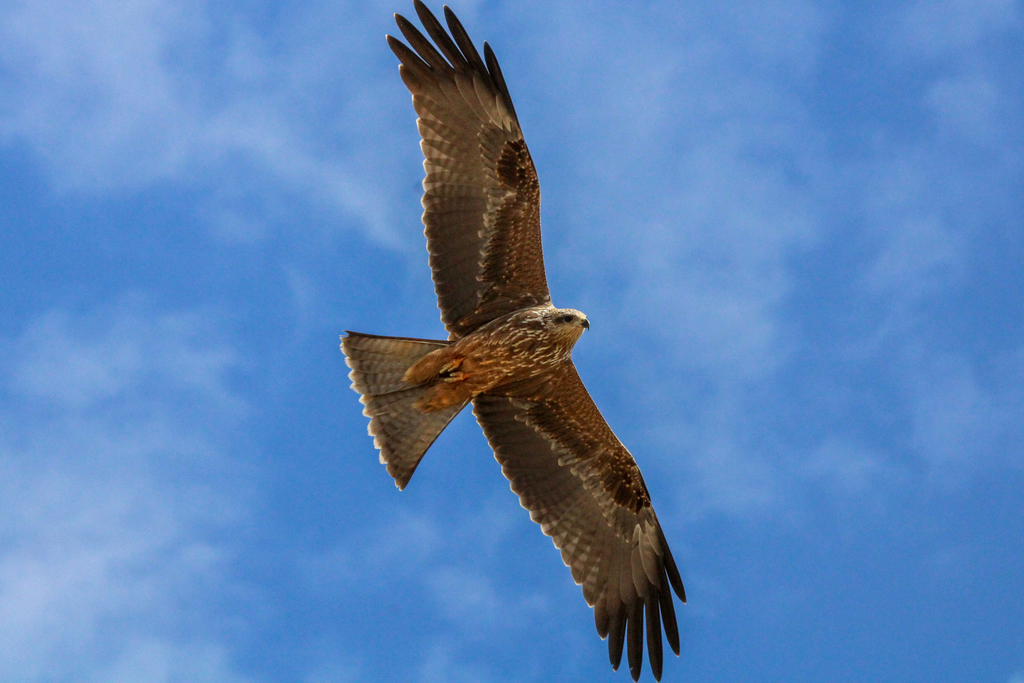
Black Kite
Milvus migrans
Habitat
Ground
Diet
VertFishScav
Active Time
Diurnal
Size
734 g
About This Species
Watch open country, wetlands, rubbish tips and river valleys across its very wide range in Europe, Asia, Africa and Australia, where this opportunistic raptor scavenges as readily as it hunts. Its shallow, forked tail is the clearest field mark in flight, distinguishing it from other similarly sized birds of prey as it wheels low over open ground. Migration periods and the breeding season bring the highest concentrations in many regions, with communal roosts sometimes forming outside the breeding season.
Ethical Viewing Guidelines
- Keep at least 50 to 100 metres from an active nest and avoid lingering underneath one, since this species can react strongly to close approach during incubation and chick-rearing.
- Legal protection for birds of prey varies across this species' very broad range, spanning strict nest-disturbance laws in parts of Europe to weaker or unenforced protections elsewhere, so do not assume one country's rules travel with the bird.
- Where communal roosts or feeding aggregations form, watching from a distance with optics rather than walking into the group avoids scattering birds that have gathered to feed or rest.
LCAvesAccipitriformesAccipitridae
Seasonal Activity
2,564,354 sightings · 2000–2026
Citizen science records via GBIF
All monthsThis month
Classification
- Kingdom
- Animalia
- Phylum
- Chordata
- Class
- Aves
- Order
- Accipitriformes
- Family
- Accipitridae
Traits
- Diet
- VertFishScav
- Foraging
- Ground
- Activity
- Diurnal
- Body mass
- 734 g
Photo
no rights reserved, uploaded by Joshua S. Martin
CC0-1.0
Occurrence data from GBIF.