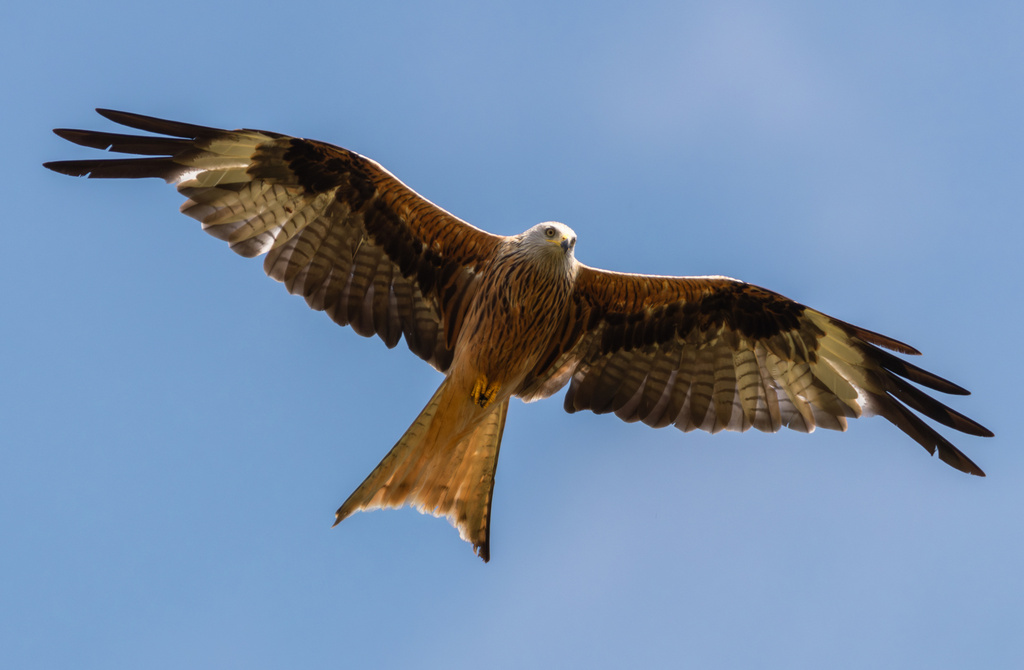
Red Kite
Milvus milvus
Habitat
Ground
Diet
VertFishScav
Active Time
Diurnal
Size
1.1 kg
About This Species
Look for this large raptor's deeply forked tail and reddish-brown plumage as it soars and tilts effortlessly over farmland, woodland edges, and river valleys, scavenging carrion and occasionally taking small live prey. It is a highly successful reintroduction species in parts of its range, and communal roosts or supplementary feeding sites can offer close, reliable views of dozens of birds at once. It can be seen year-round where resident, with numbers often easiest to observe in winter when birds concentrate at feeding stations and roosts.
Ethical Viewing Guidelines
- Keep a respectful distance from nest sites in tall trees, since even a well-established, recovering population remains vulnerable to disturbance during the breeding season.
- Legal protection for birds of prey is common across this species' range but the exact rules and penalties vary by country, so treat any nest as strictly off-limits rather than assuming a specific distance is universal.
- At feeding stations, follow site guidance on where to stand and never attempt to feed birds by hand, which encourages risky habituation to people.
Seasonal Activity
1,868,869 sightings · 2000–2026
Citizen science records via GBIF
Classification
- Kingdom
- Animalia
- Phylum
- Chordata
- Class
- Aves
- Order
- Accipitriformes
- Family
- Accipitridae
Traits
- Diet
- VertFishScav
- Foraging
- Ground
- Activity
- Diurnal
- Body mass
- 1.1 kg
Photo
(c) Manuel Raab, some rights reserved (CC BY-NC), uploaded by Manuel Raab
CC-BY-NC-4.0
Occurrence data from GBIF.