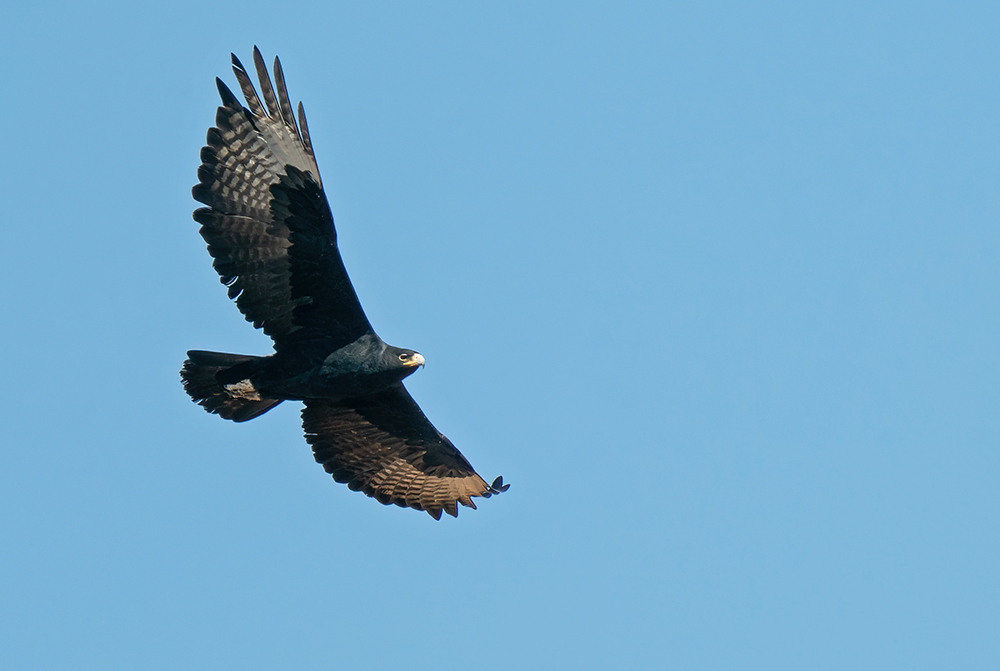
Verreaux's Eagle
Aquila verreauxii
Also known as: Black Eagle
Habitat
Ground
Diet
VertFishScav
Active Time
Diurnal
Size
4.2 kg
About This Species
Found almost exclusively in mountainous and rocky terrain where hyraxes are abundant, this large raptor spends much of its time soaring in wide, unhurried circles along cliff faces and rocky ridgelines, often hunting at dawn and dusk when hyraxes emerge to feed. Look for its striking black-and-white plumage — particularly the bold white rump and back that flash distinctively in flight — and listen for a loud, ringing call near nest sites on sheer cliff ledges. The best viewing comes during the dry season when vegetation is sparse and soaring birds are more visible against open skies; position yourself above or at the level of cliff tops in the early morning, when thermal activity begins and individuals become most active on their hunting circuits.
Ethical Viewing Guidelines
- Maintain a minimum distance of 200 metres from active nest sites, and use a spotting scope or telephoto lens rather than approaching closely, as this species is highly sensitive to human intrusion near breeding locations.
- Across its range — spanning South Africa, Namibia, Ethiopia, Kenya, and other eastern and southern African nations — it receives protection under national wildlife legislation including South Africa's National Environmental Management: Biodiversity Act and equivalent statutes in range states, so disturbance, nest interference, or collection of eggs or feathers is illegal.
- Remain quiet and still, limit observation time at any single site to avoid prolonged stress, and withdraw immediately if the bird displays agitation behaviours such as alarm calling, repeated circling, or reluctance to return to the nest.
Seasonal Activity
32,218 sightings · 2000–2026
Citizen science records via GBIF
Classification
- Kingdom
- Animalia
- Phylum
- Chordata
- Class
- Aves
- Order
- Accipitriformes
- Family
- Accipitridae
Traits
- Diet
- VertFishScav
- Foraging
- Ground
- Activity
- Diurnal
- Body mass
- 4.2 kg
Photo
(c) Paul Cools, some rights reserved (CC BY-NC), uploaded by Paul Cools
CC-BY-NC-4.0
Occurrence data from GBIF.