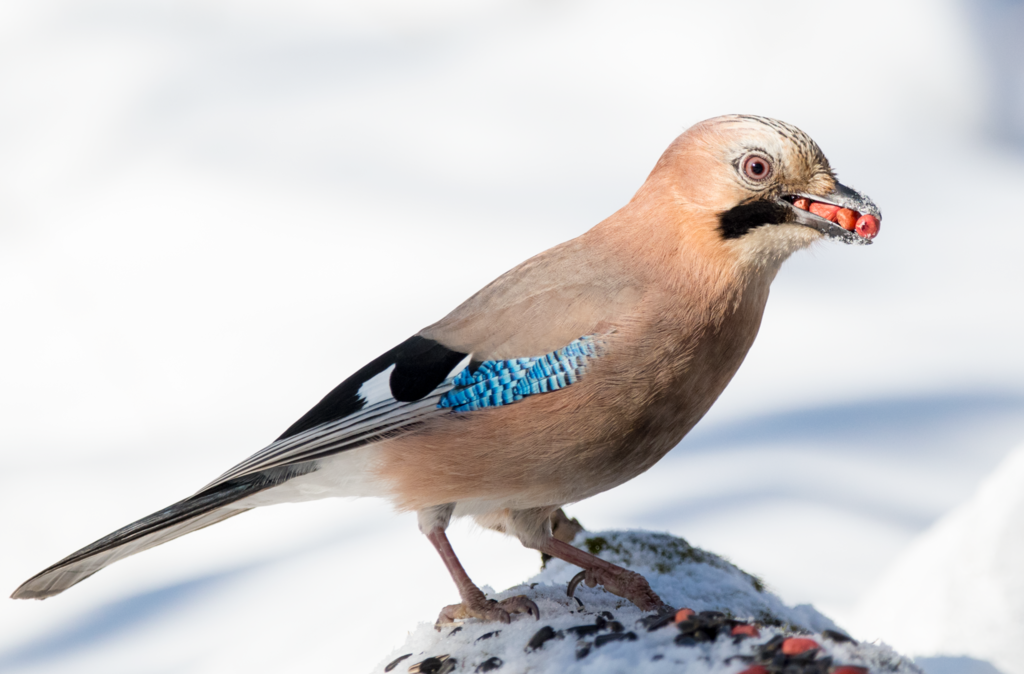
Eurasian Jay
Garrulus glandarius
Also known as: Jay
Habitat
Ground
Diet
Omnivore
Active Time
Diurnal
Size
159 g
About This Species
Look and listen in broadleaf and mixed woodland across Europe and western Asia, especially oak woods, where this pinkish-brown corvid forages on the ground and in the canopy for acorns, insects, and eggs. Its harsh, screeching call is often the first clue to its presence, since it is usually shy and quick to retreat into cover, though the flash of its blue-and-black barred wing patch in flight is distinctive. Autumn is a particularly good season, when jays are conspicuous while gathering and burying acorns for winter, a habit that makes them important tree planters in oak woodland.
Ethical Viewing Guidelines
- This is a wary woodland bird that rarely tolerates close approach, so a slow, quiet pace and binoculars from 15-20 metres will usually serve better than trying to get near; sudden movement will simply send it deeper into cover.
- Nest protection under wildlife law applies across its European range, though the specific statute and penalties differ by country, so avoid searching out or lingering near nest sites during the spring breeding season.
- Caching behavior in autumn is best watched from a distance that does not interrupt the bird's foraging routine.
Seasonal Activity
3,900,872 sightings · 2000–2026
Citizen science records via GBIF
Classification
- Kingdom
- Animalia
- Phylum
- Chordata
- Class
- Aves
- Order
- Passeriformes
- Family
- Corvidae
Traits
- Diet
- Omnivore
- Foraging
- Ground
- Activity
- Diurnal
- Body mass
- 159 g
Photo
(c) Mikhail Ezdakov, some rights reserved (CC BY-NC), uploaded by Mikhail Ezdakov
CC-BY-NC-4.0
Occurrence data from GBIF.