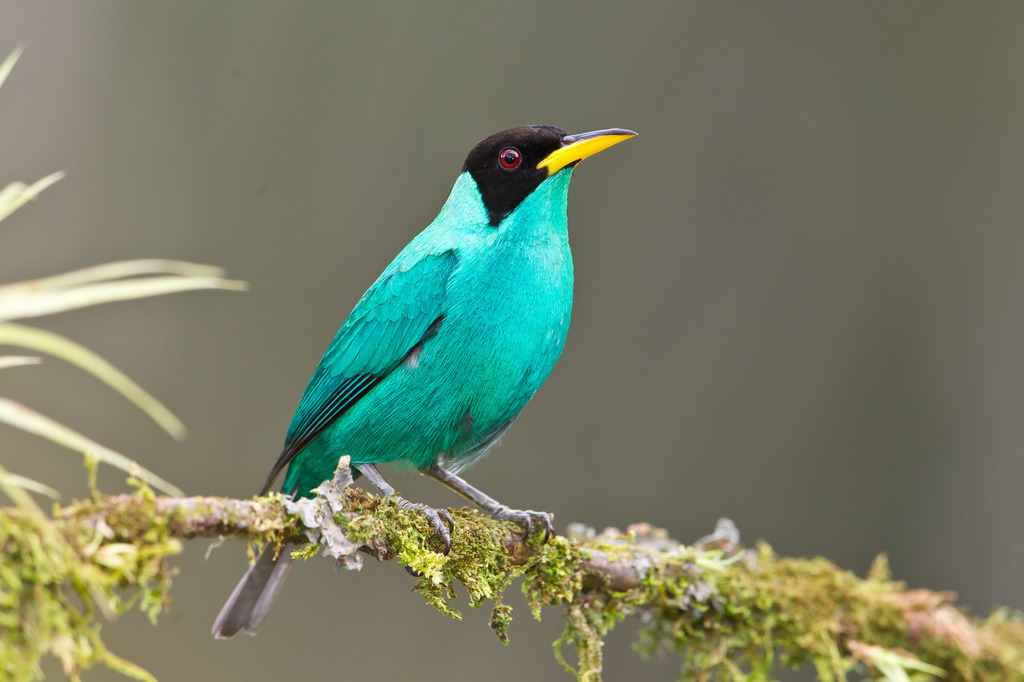
Green Honeycreeper
Chlorophanes spiza
About This Species
Found in the canopy and forest edge of lowland and foothill rainforest across Central and northern South America, often visiting fruiting trees and flowering plants in small mixed-species groups. Males are a striking turquoise-green with a black head, while females are uniformly green and can be confused with other honeycreepers, so listen for their thin, high-pitched calls to locate them. Early morning is best, when birds are most active at fruit sources, and any season works in most of its range since it does not migrate.
Ethical Viewing Guidelines
- Viewing from a stationary position near a known fruiting tree, at a distance of at least 10 to 15 metres, gives the best results without disturbing feeding birds.
- Protections vary by country across its neotropical range, and most range states restrict capture, trade, and disturbance of wild birds under national wildlife laws, so treat any handling or nest approach as off-limits.
- Keep noise and movement to a minimum and let birds continue foraging undisturbed.
LCAvesPasseriformesThraupidae
Seasonal Activity
269,917 sightings · 2000–2026
Citizen science records via GBIF
All monthsThis month
Classification
- Kingdom
- Animalia
- Phylum
- Chordata
- Class
- Aves
- Order
- Passeriformes
- Family
- Thraupidae
Photo
(c) Greg Lasley, some rights reserved (CC BY-NC), uploaded by Greg Lasley
CC-BY-NC-4.0
Occurrence data from GBIF.