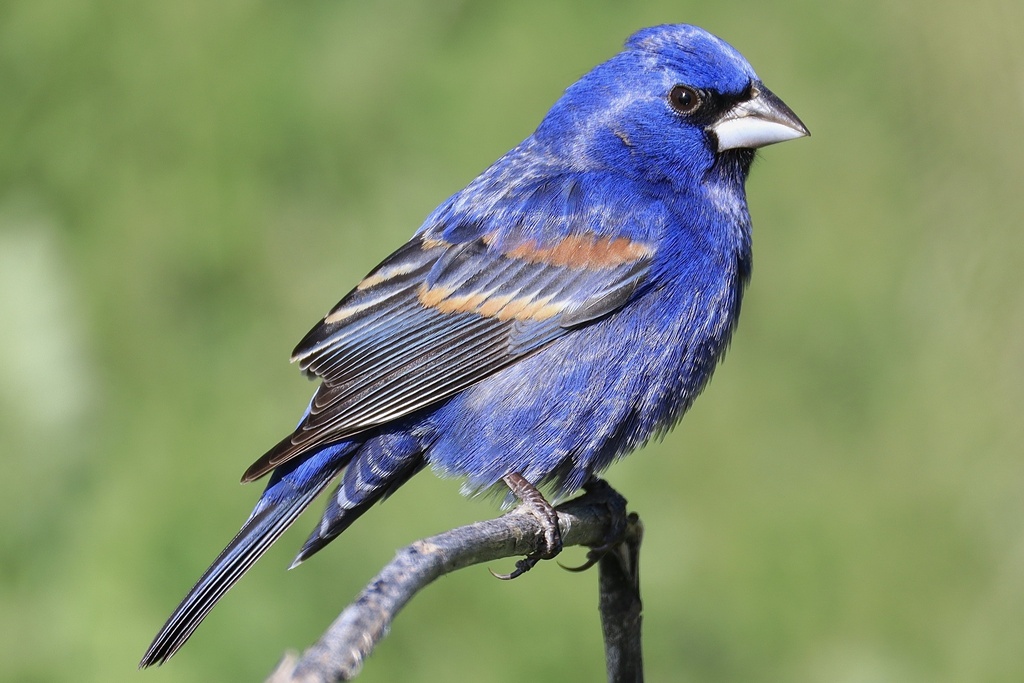
Blue Grosbeak
Passerina caerulea
Also known as: Big Indigo
About This Species
Breeding males are a deep, rich blue with chestnut wing bars, favouring brushy field edges, hedgerows and overgrown pastures across the southern and central United States in summer. Listen for a rich, warbling song delivered from an exposed perch, and watch for its habit of foraging low in dense cover before popping up to sing. It is a summer breeder that migrates to Mexico and Central America for winter, so spring through late summer is the best window to find one on its breeding grounds.
Ethical Viewing Guidelines
- A pair working a hedgerow or brush pile is easily watched from a respectful distance without approaching the nest itself, since flushing an incubating female can expose eggs or young to predators and weather.
- Migratory songbirds like this are protected under federal law in the United States and similar statutes elsewhere in its range, making it illegal to disturb active nests or collect eggs, so viewing from a distance with binoculars is both the safer and the lawful choice.
- Where the species occurs on its wintering grounds outside the US, protections and enforcement vary by country, so the same cautious, distant approach is the sensible default.
LCAvesPasseriformesCardinalidae
Seasonal Activity
1,224,248 sightings · 2000–2026
Citizen science records via GBIF
All monthsThis month
Classification
- Kingdom
- Animalia
- Phylum
- Chordata
- Class
- Aves
- Order
- Passeriformes
- Family
- Cardinalidae
Photo
(c) Cyrus Li, some rights reserved (CC BY-NC), uploaded by Cyrus Li
CC-BY-NC-4.0
Occurrence data from GBIF.