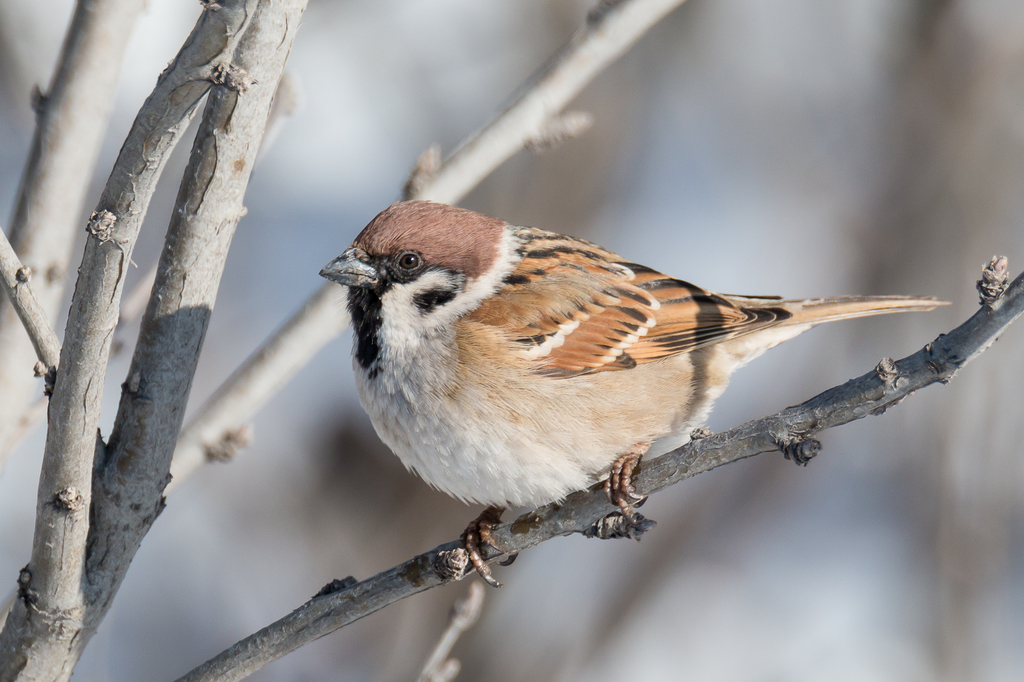
Eurasian Tree Sparrow
Passer montanus
Also known as: Tree Sparrow, Eurasian Sparrow, Pardal Xarrec
Habitat
Ground
Diet
PlantSeed
Active Time
Diurnal
Size
21 g
About This Species
Look around farmland, hedgerows, villages, and woodland edges across Europe and Asia, where small flocks forage on the ground for seeds and search hedges and scrub for insects. It resembles the House Sparrow but is smaller, with a neat chestnut-brown cap and a distinct black cheek spot that separates the two at a glance. Spring through summer is best for observing nesting activity around old buildings, tree cavities, and nest boxes, while autumn and winter bring larger mixed flocks feeding on stubble fields and seed heads.
Ethical Viewing Guidelines
- A generally approachable species in villages and farmyards, but active nests in cavities and boxes should still be left undisturbed, and observation from several metres away with binoculars is preferable to peering directly into nest holes.
- Legal protection for nesting birds varies across its wide Eurasian range, with the UK and EU offering statutory protection during the breeding season, so treat nest disturbance as off-limits regardless of how tame the local flock seems.
- Where the species has been introduced outside its native range, local rules may differ, so check regional guidance rather than assuming uniform protection.
Seasonal Activity
3,855,108 sightings · 2000–2026
Citizen science records via GBIF
Classification
- Kingdom
- Animalia
- Phylum
- Chordata
- Class
- Aves
- Order
- Passeriformes
- Family
- Passeridae
Traits
- Diet
- PlantSeed
- Foraging
- Ground
- Activity
- Diurnal
- Body mass
- 21 g
Photo
(c) Dina Nesterkova, some rights reserved (CC BY-NC), uploaded by Dina Nesterkova
CC-BY-NC-4.0
Occurrence data from GBIF.