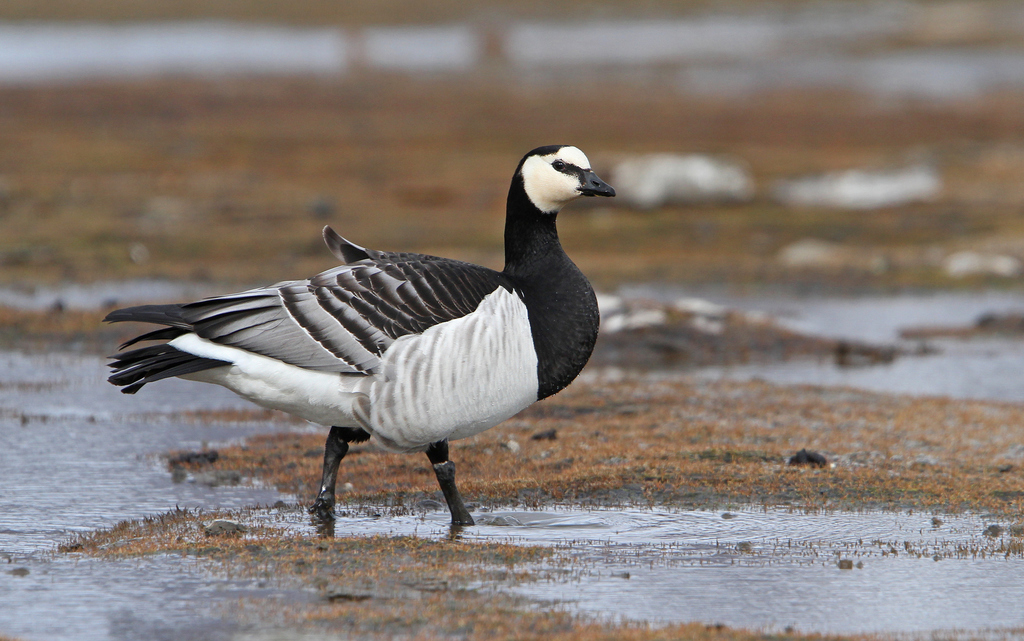
Barnacle Goose
Branta leucopsis
Also known as: Greenland Barnacle Goose, Naturalised Barnacle Goose, Svalbard Barnacle Goose
Habitat
Ground
Diet
PlantSeed
Active Time
Diurnal
Size
1.7 kg
About This Species
Look for large, tightly packed flocks grazing on coastal grasslands and saltmarsh, easily told by the striking black, white and grey plumage and black face. Wintering birds gather on estuaries and farmland in the UK, Ireland and the Netherlands after breeding in the high Arctic of Svalbard, Greenland and Russia. Cold, clear winter mornings are best, when flocks feed steadily on short grass before flying to roost on open water or mudflats.
Ethical Viewing Guidelines
- Keep at least 50 metres from feeding or roosting flocks, since flushing a large goose flock wastes the energy reserves they depend on through winter.
- In the UK and EU, wild geese and their habitats receive protection under wildlife legislation including close seasons on shooting, though rules differ between countries within its wintering range.
- Where flocks feed near footpaths, stay on the path and avoid dogs off lead nearby.
Seasonal Activity
1,520,103 sightings · 2000–2026
Citizen science records via GBIF
Classification
- Kingdom
- Animalia
- Phylum
- Chordata
- Class
- Aves
- Order
- Anseriformes
- Family
- Anatidae
Traits
- Diet
- PlantSeed
- Foraging
- Ground
- Activity
- Diurnal
- Body mass
- 1.7 kg
Photo
(c) Christoph Moning, some rights reserved (CC BY), uploaded by Christoph Moning
CC-BY-4.0
Occurrence data from GBIF.