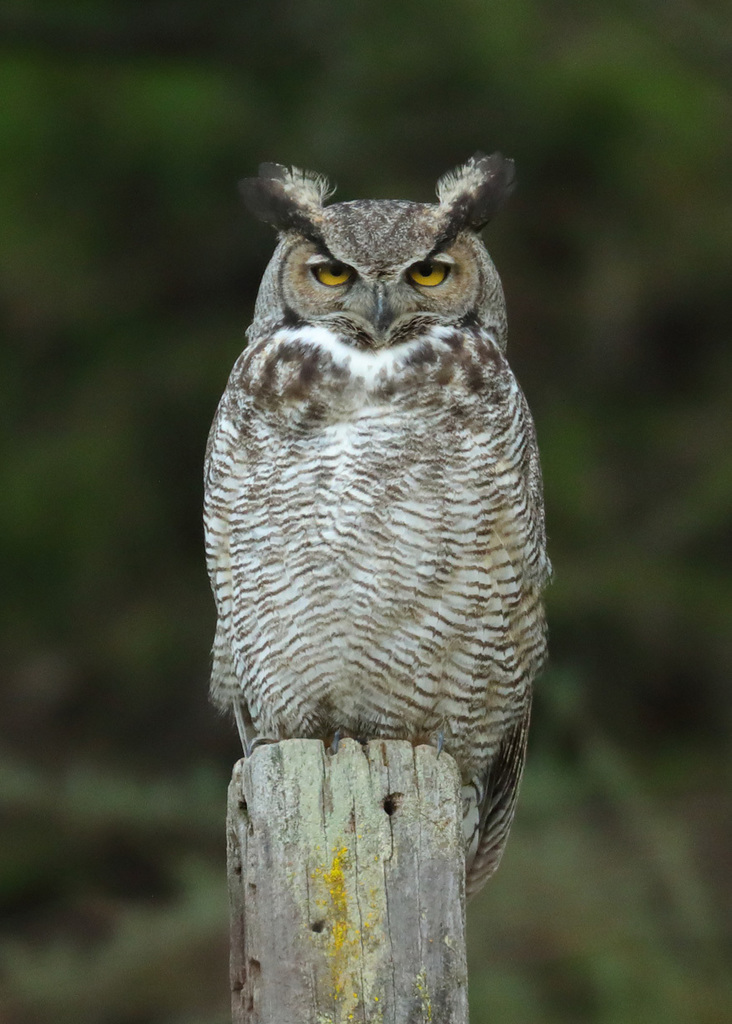
Great Horned Owl
Bubo virginianus
Habitat
Ground
Diet
VertFishScav
Active Time
Nocturnal
Size
1.6 kg
About This Species
Found across a sweeping range of habitats from dense forest edges to suburban parks, this large owl favors areas where open hunting grounds adjoin mature trees with deep cavities or old raptor nests it can commandeer for roosting and nesting. Listen after dark for its deep, resonant series of booming hoots — typically a five-note phrase with a stuttered middle — and scan bare branches, fence posts, and utility poles where it perches motionless while scanning the ground below for mice, rabbits, and other prey. Winter offers the best viewing opportunities, as bare deciduous trees expose roosting birds more readily and breeding activity begins as early as January or February, when pairs call back and forth at dusk from territories they hold year-round.
Ethical Viewing Guidelines
- Maintain a minimum distance of 30 metres, using binoculars or a spotting scope to observe without encroaching on roosting or nesting sites.
- Across its range, this species is protected under the U.S.
- Migratory Bird Treaty Act, Canada's Migratory Birds Convention Act, and equivalent provincial and Mexican federal wildlife regulations, all of which prohibit deliberate disturbance, harassment, or take.
- Avoid prolonged observation near active nests, never use playback calls during the breeding season, and withdraw immediately if the bird shows signs of alertness or agitation such as bill-clacking, feather-raising, or repeated head-turning toward you.
Seasonal Activity
1,543,921 sightings · 2000–2026
Citizen science records via GBIF
Classification
- Kingdom
- Animalia
- Phylum
- Chordata
- Class
- Aves
- Order
- Strigiformes
- Family
- Strigidae
Traits
- Diet
- VertFishScav
- Foraging
- Ground
- Activity
- Nocturnal
- Body mass
- 1.6 kg
Photo
(c) Paul G. Johnson, some rights reserved (CC BY-NC-SA), uploaded by Paul G. Johnson
CC-BY-NC-SA-4.0
Occurrence data from GBIF.