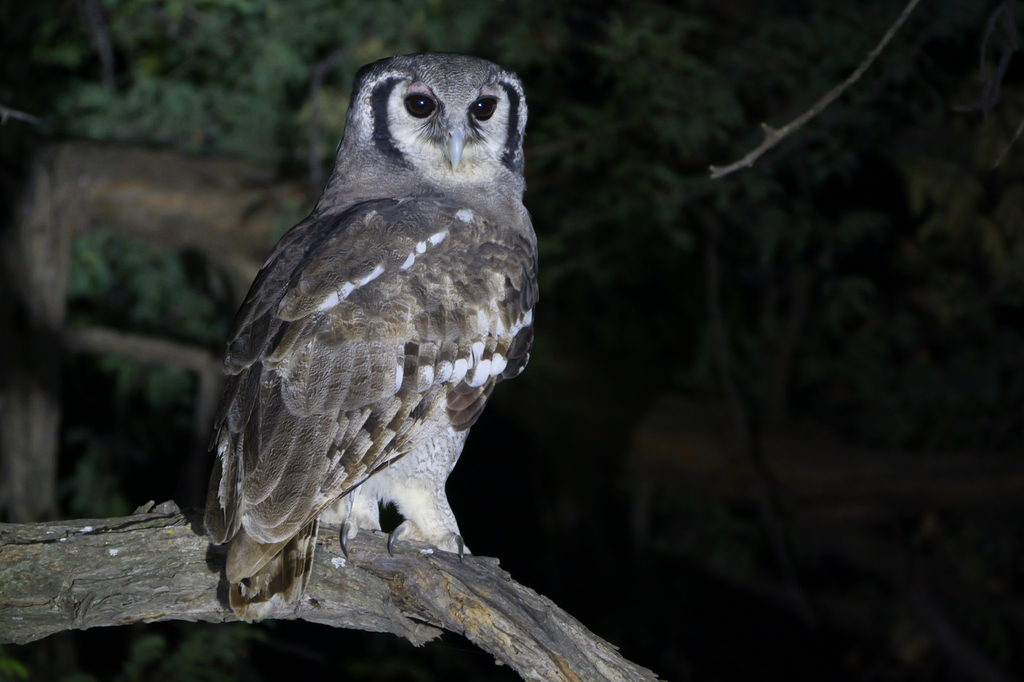
Verreaux's Eagle-Owl
Bubo lacteus
Also known as: Giant Eagle Owl
Habitat
Ground
Diet
VertFishScav
Active Time
Nocturnal
Size
2.1 kg
About This Species
Found in mature woodland, savanna, and riverine forest across sub-Saharan Africa, this massive owl favors large trees — particularly fig and acacia — for daytime roosting, and hunts on or near the ground for prey ranging from hedgehogs to monitor lizards and even other raptors. Look for the distinctive pale pink eyelids and the large rounded silhouette perched low and still in dense canopy during daylight hours, and listen after dark for the deep, booming double hoot — a resonant *hu-huu* — that carries far through the night air. The dry season offers the best viewing opportunities, when leafless trees expose roost sites and pairs become vocal and conspicuous during courtship and nesting activity, with early evening the prime window as birds begin calling and moving before full darkness sets in.
Ethical Viewing Guidelines
- Maintain a minimum distance of 30–50 metres, using a vehicle or hide as a blind where possible, and avoid approaching active nest sites, particularly during breeding season when adults are highly sensitive to disturbance.
- Across its sub-Saharan African range, it is protected under national wildlife legislation in countries including South Africa (National Environmental Management: Biodiversity Act), Kenya (Wildlife Conservation and Management Act), and Tanzania (Wildlife Conservation Act), with additional coverage under CITES Appendix II governing any trade.
- Use passive observation methods — keep noise to a minimum, limit time spent at roost sites, and never use playback calls or artificial lighting, which can disrupt natural behaviour and cause unnecessary stress.
Seasonal Activity
27,278 sightings · 2000–2026
Citizen science records via GBIF
Classification
- Kingdom
- Animalia
- Phylum
- Chordata
- Class
- Aves
- Order
- Strigiformes
- Family
- Strigidae
Traits
- Diet
- VertFishScav
- Foraging
- Ground
- Activity
- Nocturnal
- Body mass
- 2.1 kg
Photo
(c) toulao63, some rights reserved (CC BY-NC)
CC-BY-NC-4.0
Occurrence data from GBIF.