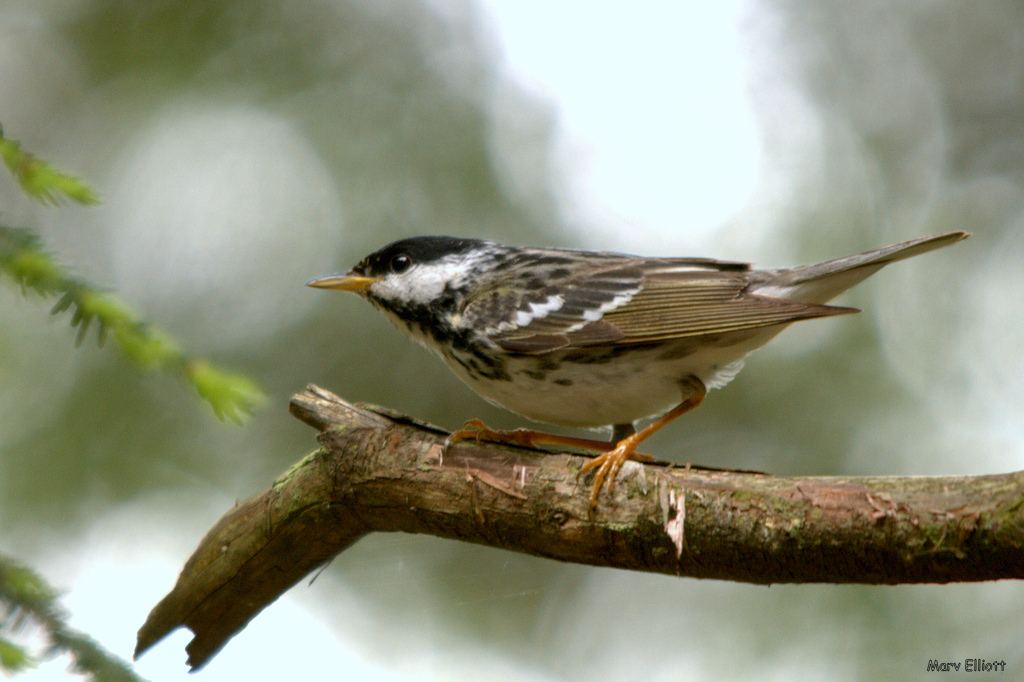
Blackpoll Warbler
Setophaga striata
Also known as: Black-Polled Warbler
About This Species
In the breeding season this warbler favours dense spruce and fir forest across the boreal north, where it forages high in the canopy and sings a very high, thin, insect-like trill that can be hard for some observers to hear. It is best known for an extraordinary autumn migration, when birds stage on the Atlantic coast before making a long non-stop flight over open ocean to South America. Coastal woodland in September and early October, during migration stopover, is often the most reliable place to see one well.
Ethical Viewing Guidelines
- Because this species is listed as Near Threatened, treat sightings with extra care: watch from a distance with binoculars, keep to trails, and never use recordings or playback to draw a bird in for a better look, since repeated calling disrupts feeding and rest during an already demanding migration.
- Native birds are protected under law in both its Canada/US breeding range and along its Latin American migration corridor, though the details differ by country.
- Give stopover habitat, such as coastal thickets in migration season, extra space rather than pushing in for a closer view.
NTAvesPasseriformesParulidae
Seasonal Activity
1,002,730 sightings · 2000–2026
Citizen science records via GBIF
All monthsThis month
Classification
- Kingdom
- Animalia
- Phylum
- Chordata
- Class
- Aves
- Order
- Passeriformes
- Family
- Parulidae
Photo
(c) Marv Elliott, some rights reserved (CC BY-NC), uploaded by Marv Elliott
CC-BY-NC-4.0
Occurrence data from GBIF.