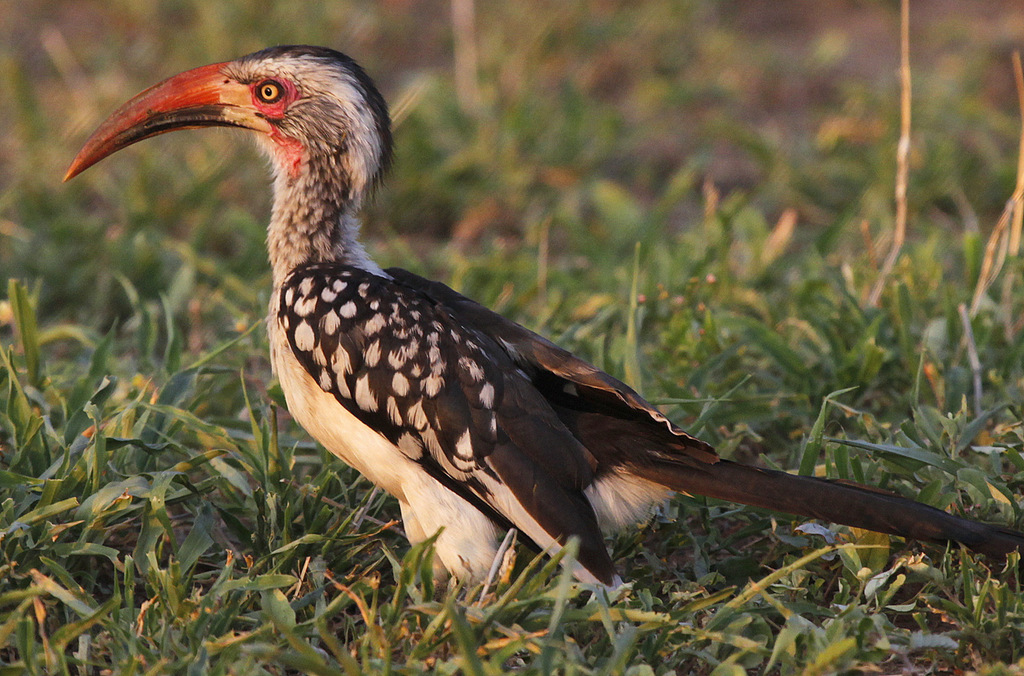
Southern Red-Billed Hornbill
Tockus rufirostris
About This Species
A small, social hornbill of dry savanna and thornbush, typically encountered foraging on or near the ground for insects, small vertebrates, and fallen fruit, often in loose pairs or family groups. The vivid red bill is unmistakable in flight or at close range, and the species produces a loud, accelerating series of clucking calls that carry well across open ground — learn this call and you will often hear them before you see them. Dry season mornings are the most productive time to search, when reduced vegetation makes spotting easier and individuals are active early, working the edges of clearings and bare patches beneath acacia and mopane woodland.
Ethical Viewing Guidelines
- Maintain a minimum distance of 10–15 metres, increasing to at least 30 metres during nesting season when females are sealed inside tree cavities, as disturbance at this stage can cause nest abandonment.
- Across its range in southern and eastern Africa, it is protected under national wildlife legislation in countries including South Africa (National Environmental Management: Biodiversity Act), Zimbabwe, Botswana, and Namibia, where capturing, handling, or disturbing nesting birds without a permit is prohibited.
- Use binoculars or a telephoto lens rather than approaching closely, avoid lingering near active nest trees, and never attempt to interfere with the sealed nest entrance, as the female is wholly dependent on the male for food delivery during this vulnerable period.
Seasonal Activity
51,517 sightings · 2000–2026
Citizen science records via GBIF
Classification
- Kingdom
- Animalia
- Phylum
- Chordata
- Class
- Aves
- Order
- Bucerotiformes
- Family
- Bucerotidae
Photo
(c) Carmelo López Abad, some rights reserved (CC BY-NC), uploaded by Carmelo López Abad
CC-BY-NC-4.0
Occurrence data from GBIF.