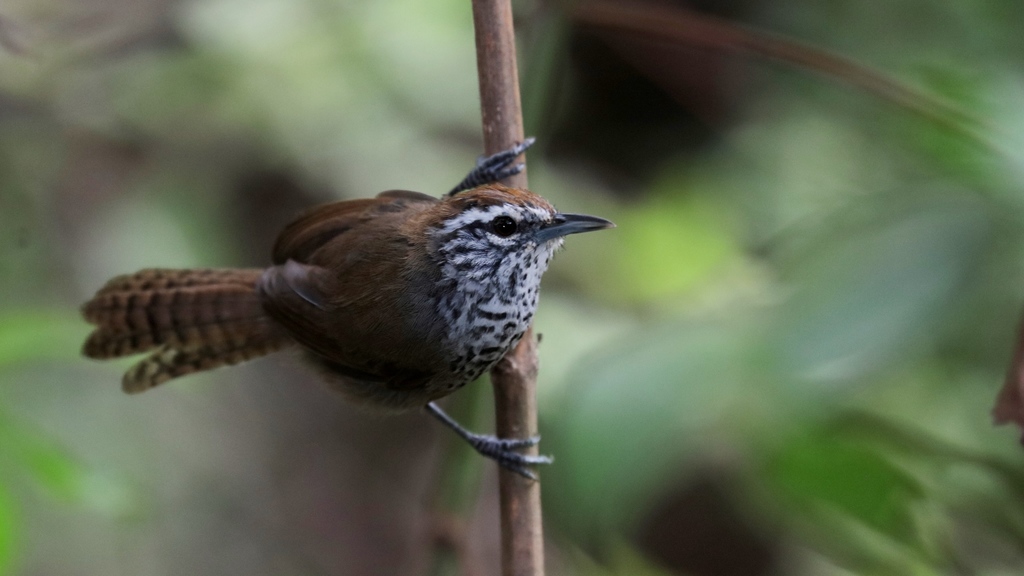
Spot-Breasted Wren
Pheugopedius maculipectus
About This Species
Found in dense undergrowth and thicket habitat in Central American lowland and foothill forest, usually staying low and close to cover rather than in the open canopy. Pairs are often detected by their loud, rich duetted song before they are seen, so listening carefully near forest edges and overgrown clearings is more productive than scanning by eye. Early morning, when duetting activity peaks, gives the best chance of a view as a bird briefly pops into sight near ground level.
Ethical Viewing Guidelines
- Because it favours thick, tangled vegetation, the best approach is to stay still near a likely duetting pair and let the bird come into view rather than pushing into the undergrowth after it.
- General protections for native wildlife and habitat apply across its Central American range, though specifics vary by country, so avoid cutting or disturbing vegetation to get a better look.
- A slow, patient approach from a fixed spot causes far less disturbance than following the bird through cover.
LCAvesPasseriformesTroglodytidae
Seasonal Activity
188,881 sightings · 2000–2026
Citizen science records via GBIF
All monthsThis month
Classification
- Kingdom
- Animalia
- Phylum
- Chordata
- Class
- Aves
- Order
- Passeriformes
- Family
- Troglodytidae
Photo
(c) Roberto González, some rights reserved (CC BY-NC), uploaded by Roberto González
CC-BY-NC-4.0
Occurrence data from GBIF.