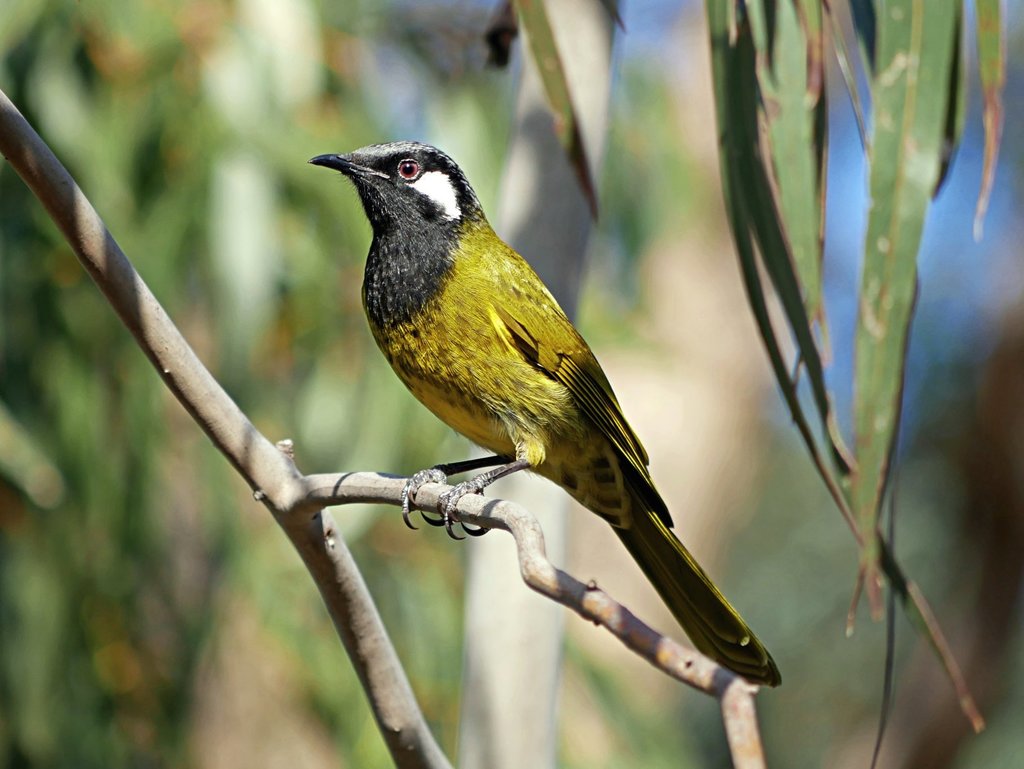
White-Eared Honeyeater
Nesoptilotis leucotis
About This Species
This honeyeater favours dry eucalypt forest, woodland, and coastal heath in southeastern Australia, gleaning insects from foliage and bark and visiting flowering banksias and eucalypts for nectar. Its olive-green body and bold white ear patch against a black head are distinctive at close range, and its ringing, repetitive call often gives away its presence before it is seen. Spring flowering season tends to concentrate several honeyeater species, including this one, at the same nectar sources.
Ethical Viewing Guidelines
- A few metres' distance from a feeding bird at a flowering shrub is generally enough for good views without causing it to move off.
- It carries no special conservation status, but Australian state wildlife legislation protects native birds generally, prohibiting capture or nest disturbance, and it is good practice to avoid lingering near an active nest in dense shrubbery during spring.
- Photographing at feeding sites rather than nests avoids most disturbance concerns.
LCAvesPasseriformesMeliphagidae
Seasonal Activity
206,008 sightings · 2000–2026
Citizen science records via GBIF
All monthsThis month
Classification
- Kingdom
- Animalia
- Phylum
- Chordata
- Class
- Aves
- Order
- Passeriformes
- Family
- Meliphagidae
Photo
(c) Paul George, some rights reserved (CC BY-NC-SA), uploaded by Paul George
CC-BY-NC-SA-4.0
Occurrence data from GBIF.