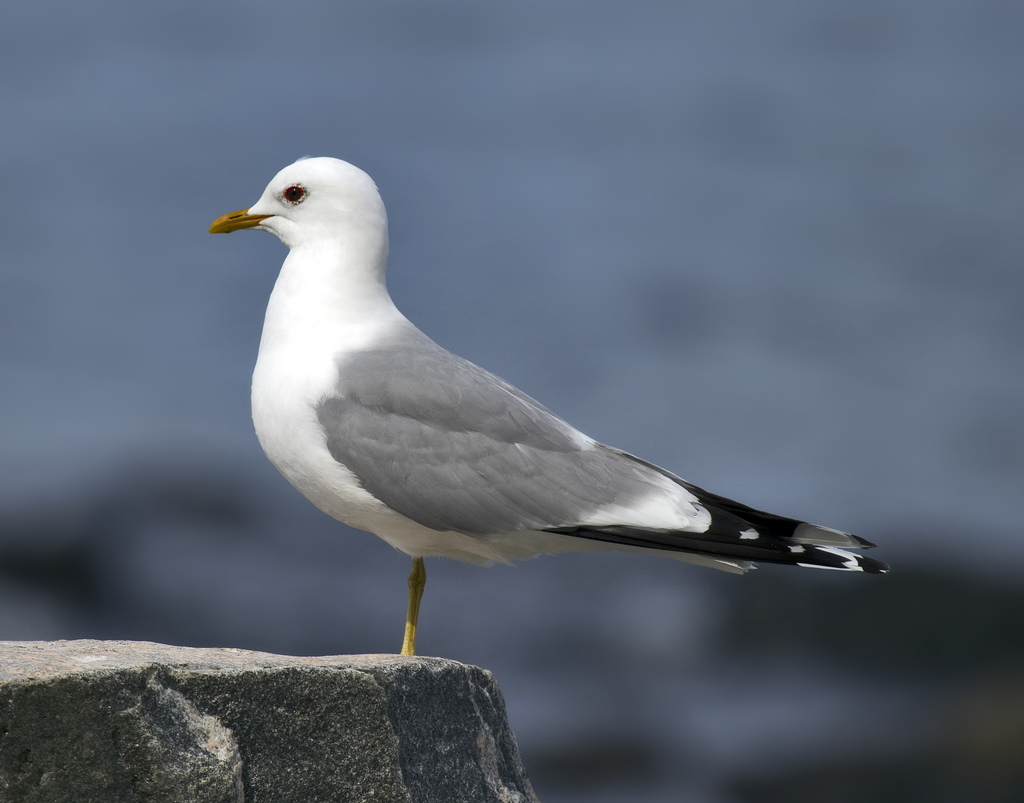
Mew Gull
Larus canus
Also known as: Common Gull
Habitat
Aquatic
Diet
Omnivore
Active Time
Diurnal
Size
413 g
About This Species
A small, gentle-faced gull of coastal waters, estuaries, and inland lakes across its range in Eurasia and northwestern North America (where it is also known as the Short-billed Gull), often seen resting in mixed gull flocks on beaches or foraging by wading in shallow water and picking prey from the surface. Winter brings the largest concentrations to sheltered coasts and harbors, when it associates with larger gull species and can be picked out by its smaller size, rounded head, and unmarked yellow-green bill. Listen for a higher-pitched, more mewing call than the larger gulls it associates with.
Ethical Viewing Guidelines
- Gulls loafing on beaches or harbors generally tolerate moderate approach distances, but walking directly at a resting flock still causes unnecessary flushing, so a slow oblique approach or simply waiting nearby works better.
- Wild bird protections vary by country across its range, spanning the UK's Wildlife and Countryside Act, the EU Birds Directive, and Canada's migratory bird legislation, all of which prohibit disturbing nesting birds, so care during the breeding season on coastal cliffs and islands matters more than in winter roosts.
- Avoiding deliberate flushing of resting flocks, especially in cold weather, keeps disturbance to a minimum.
Seasonal Activity
2,828,511 sightings · 2000–2026
Citizen science records via GBIF
Classification
- Kingdom
- Animalia
- Phylum
- Chordata
- Class
- Aves
- Order
- Charadriiformes
- Family
- Laridae
Traits
- Diet
- Omnivore
- Foraging
- Aquatic
- Activity
- Diurnal
- Body mass
- 413 g
Photo
(c) Andreas Trepte, some rights reserved (CC BY-SA)
CC-BY-SA-4.0
Occurrence data from GBIF.