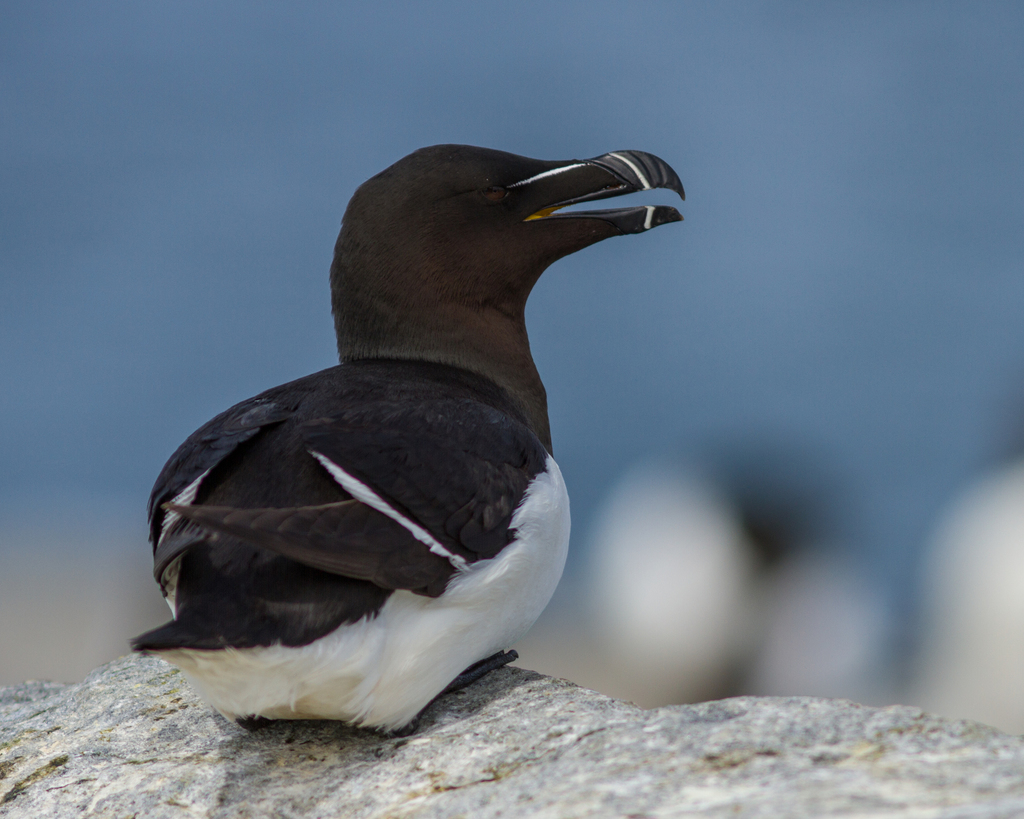
Razorbill
Alca torda
Habitat
Aquatic
Diet
VertFishScav
Active Time
Diurnal
Size
726 g
About This Species
Look for compact, black-and-white auks riding swells just offshore or diving repeatedly in pursuit of small fish, typically in cold inshore waters, sea cliffs, and rocky coastal edges during the breeding season from April through July. The blunt, deep bill with its distinctive white vertical groove and transverse bar is the key field mark at close range, while the cocked tail and thick-necked silhouette distinguish it in flight from similar species. Dawn and dusk activity tends to be most pronounced around colony sites, where the low, growling calls carry from crevices and ledge gatherings; outside the breeding season, scan rocky headlands and sheltered bays during calm, clear days when surface visibility makes diving birds easy to track.
Ethical Viewing Guidelines
- Maintain a minimum distance of 50 metres from nesting colonies, using binoculars or a spotting scope to observe without encroaching on cliff ledges and breeding sites.
- Across its range, nesting birds are protected under the EU Birds Directive, the UK Wildlife and Countryside Act 1981, and equivalent legislation in North America such as the Migratory Bird Treaty Act, all of which prohibit intentional disturbance at or near the nest.
- Approach slowly and quietly from downwind, avoid prolonged visits during the breeding season (April–July), and never use playback calls or drones near colonies, as repeated disturbance can cause nest abandonment and chick mortality.
Seasonal Activity
578,898 sightings · 2000–2026
Citizen science records via GBIF
Classification
- Kingdom
- Animalia
- Phylum
- Chordata
- Class
- Aves
- Order
- Charadriiformes
- Family
- Alcidae
Traits
- Diet
- VertFishScav
- Foraging
- Aquatic
- Activity
- Diurnal
- Body mass
- 726 g
Photo
(c) dkirschke, some rights reserved (CC BY-NC)
CC-BY-NC-4.0
Occurrence data from GBIF.