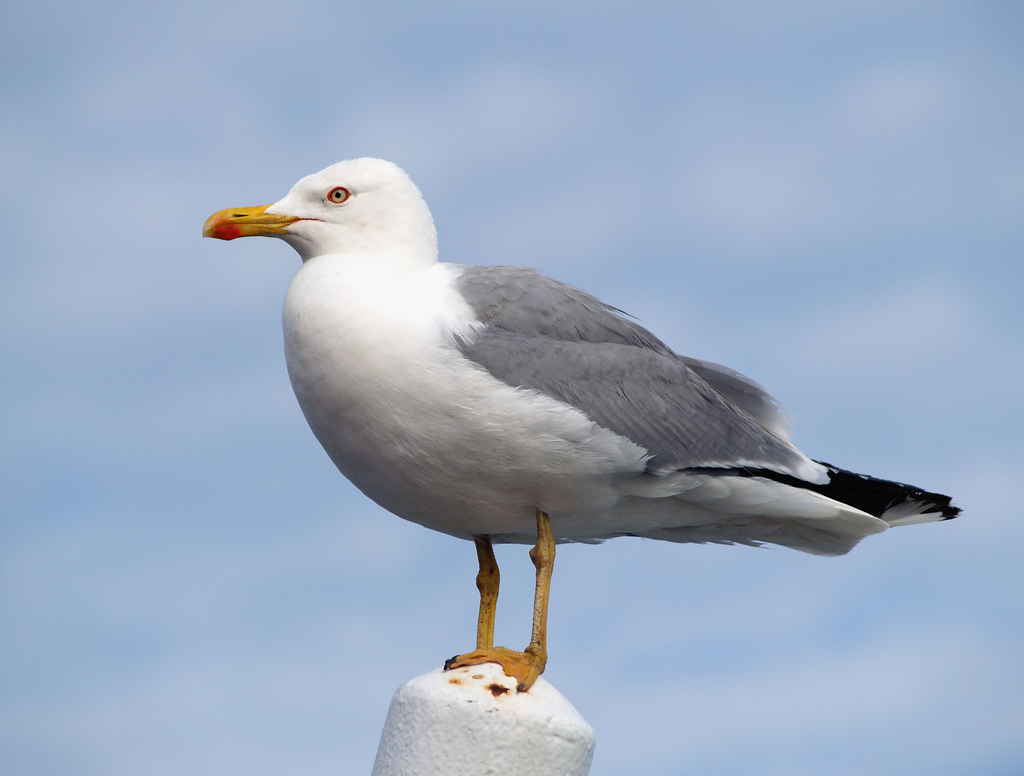
Yellow-Legged Gull
Larus michahellis
Habitat
Aquatic
Diet
VertFishScav
Active Time
Diurnal
Size
1.1 kg
About This Species
Yellow-Legged Gulls are a common sight around Mediterranean and southern European coastlines, harbours, and cliffs, scavenging around fishing boats and rubbish sites as readily as foraging naturally along the shore. Adults show a clean grey back, yellow legs, and a red spot on the bill, distinguishing them from similar large gulls with careful comparison. They can be seen year-round in much of their range, with large colonies most active and easiest to observe on breeding cliffs and islands in spring and early summer.
Ethical Viewing Guidelines
- Around harbours and beaches this species is generally tolerant of close human presence, though a respectful distance of a few metres avoids provoking defensive behaviour, especially near food.
- Wild bird protection laws apply across its European range, but enforcement and specific rules differ by country, so treat local signage and guidance as authoritative rather than assuming a blanket standard.
- Avoid approaching breeding cliffs or colonies directly, since flushed adults leave chicks and eggs exposed to predation and heat.
Seasonal Activity
1,738,951 sightings · 2000–2026
Citizen science records via GBIF
Classification
- Kingdom
- Animalia
- Phylum
- Chordata
- Class
- Aves
- Order
- Charadriiformes
- Family
- Laridae
Traits
- Diet
- VertFishScav
- Foraging
- Aquatic
- Activity
- Diurnal
- Body mass
- 1.1 kg
Photo
(c) Jörg Hempel, some rights reserved (CC BY-SA), uploaded by Jörg Hempel
CC-BY-SA-4.0
Occurrence data from GBIF.