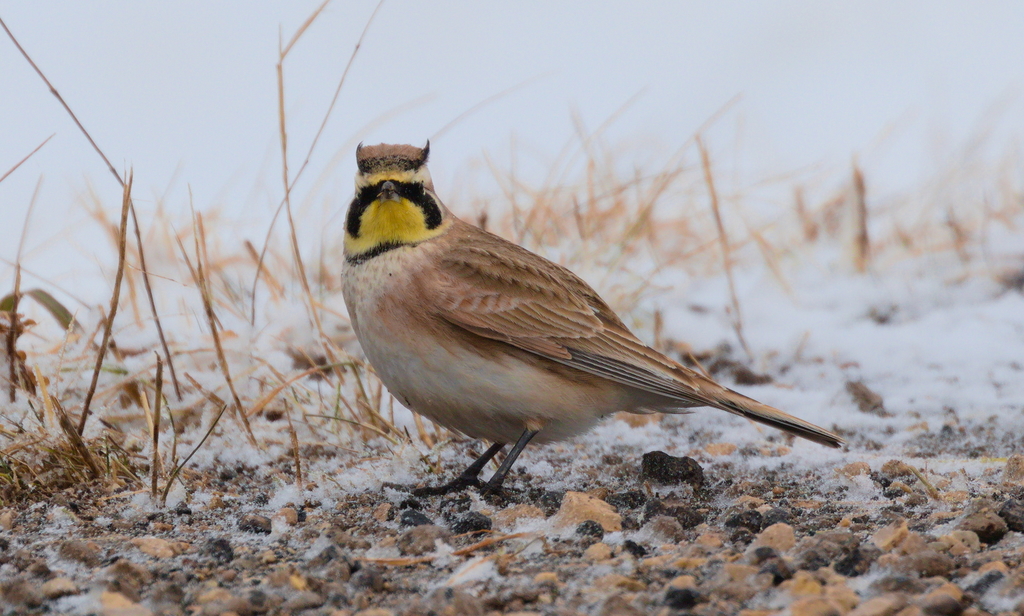
Horned Lark
Eremophila alpestris
Also known as: Shore Lark, Common Horned Lark, Shorelark
Habitat
Ground
Diet
Omnivore
Active Time
Diurnal
Size
33 g
About This Species
This ground-dwelling songbird favours short-grass prairie, tundra, alpine meadows, and bare or sparsely vegetated fields, where its streaky brown plumage and small black "horns" of feathers can be surprisingly easy to miss until it moves. Listen for its thin, tinkling flight song, often given high overhead during display flights, and watch for small flocks walking and running across open ground rather than hopping. Winter is often the best time to see larger numbers, when flocks gather in stubble fields, plowed farmland, and along roadsides in open country.
Ethical Viewing Guidelines
- Approach slowly and stay in a vehicle where possible, since flocks feeding in open fields flush easily and repeated disturbance can push birds away from limited winter feeding areas.
- Protections for migratory songbirds and their nests vary by country across this species' wide range, so check local rules if nesting activity is suspected rather than assuming a single standard applies everywhere.
- Keep a respectful distance from any bird sitting tight on the ground in breeding season, since it may be incubating eggs in a shallow scrape that is easy to overlook.
Seasonal Activity
1,871,679 sightings · 2000–2026
Citizen science records via GBIF
Classification
- Kingdom
- Animalia
- Phylum
- Chordata
- Class
- Aves
- Order
- Passeriformes
- Family
- Alaudidae
Traits
- Diet
- Omnivore
- Foraging
- Ground
- Activity
- Diurnal
- Body mass
- 33 g
Photo
(c) mannac, some rights reserved (CC BY-NC), uploaded by mannac
CC-BY-NC-4.0
Occurrence data from GBIF.