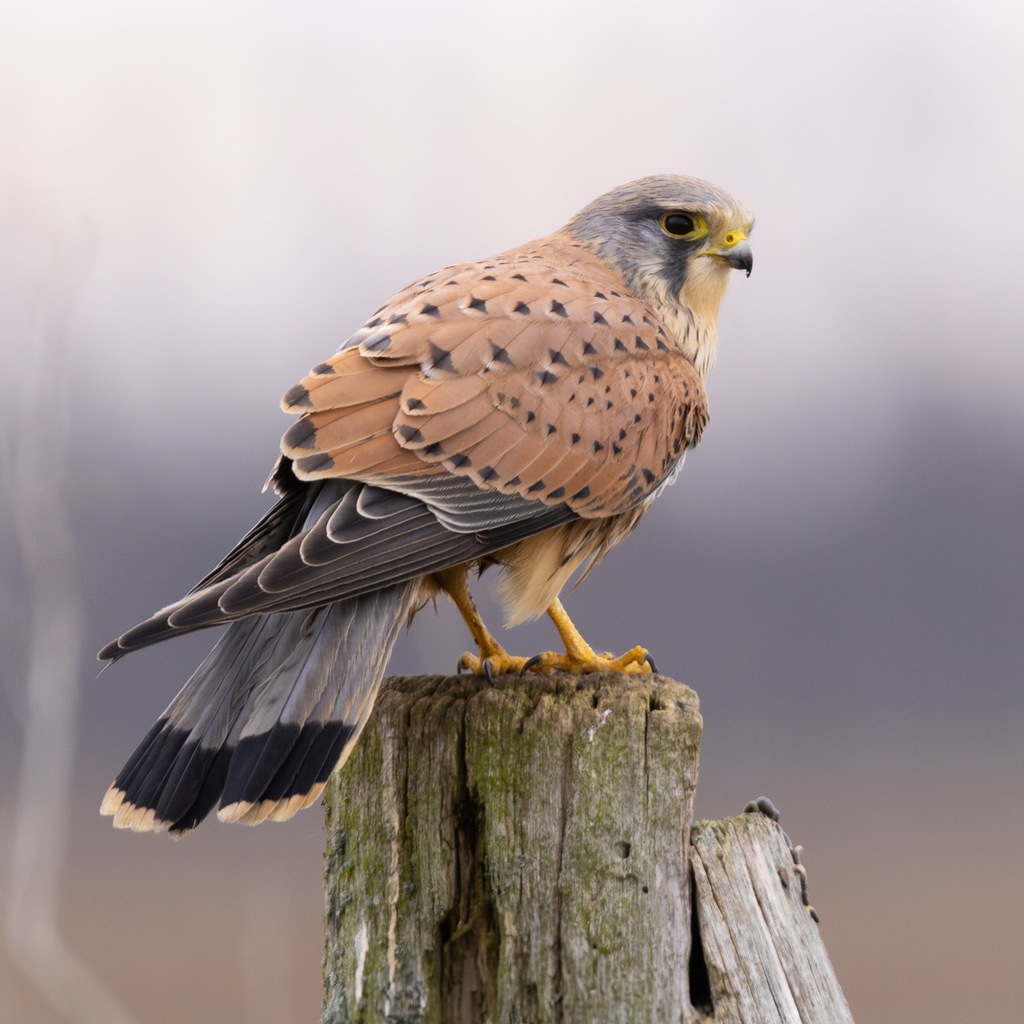
Common Kestrel
Falco tinnunculus
Also known as: Eurasian Kestrel, Kestrel
Habitat
Ground
Diet
VertFishScav
Active Time
Diurnal
Size
183 g
About This Species
A small falcon readily identified by its distinctive hunting technique: hovering on rapidly beating wings with its tail fanned while scanning rough grassland, road verges and farmland below for small mammals. It favours open country with elevated perches such as posts, pylons and wires, from which it watches for prey between hovering bouts. Roadside verges and open farmland in any season offer reliable sightings, though clear, calm conditions make hovering easier to spot from a distance.
Ethical Viewing Guidelines
- This is a species best watched from a vehicle or at range with binoculars, since it will abandon a hunting perch or hover if approached too closely on foot, wasting energy it needs for successful hunts.
- It and its nest are legally protected across its range, with penalties for deliberate disturbance near an active nest during the breeding season in several countries, so keep well back from any cliff ledge, tree cavity or building nest site.
- Where protections differ between countries, treat any occupied nest as off-limits to close approach regardless of local specifics.
Seasonal Activity
5,143,140 sightings · 2000–2026
Citizen science records via GBIF
Classification
- Kingdom
- Animalia
- Phylum
- Chordata
- Class
- Aves
- Order
- Falconiformes
- Family
- Falconidae
Traits
- Diet
- VertFishScav
- Foraging
- Ground
- Activity
- Diurnal
- Body mass
- 183 g
Photo
(c) Manuel Raab, some rights reserved (CC BY-NC), uploaded by Manuel Raab
CC-BY-NC-4.0
Occurrence data from GBIF.